
Software / Decision Table
Decision-making, made visible.
Decision Table is software for the choices that sit between strategic intent and business planning.
Before funding, capacity, executive attention and organisational energy are absorbed, leaders need a governed way to understand what kind of choice is in front of them.
Decision Table complements strategic planning by turning proposed change into a visible funnel, so options can be categorised, assessed, held, reshaped or committed with discipline.
The problem
The business commits capital before the choice is understood.
Capital includes time, funding, capacity, optionality, executive attention and the organisational energy required to make change real.
Most businesses expose that capital before a choice has been properly understood.
A good idea becomes a conversation. Then a priority. Then an assumption. By the time anyone asks what should be protected, what should be declined or what can still be reversed, the organisation has already absorbed cost, attention and expectation.
Decision Table creates the discipline before commitment hardens.
The symptoms are familiar.
Ideas become commitments too quickly.
A change enters the business. People agree it seems important. The organisation starts behaving as if the choice has already been made before the exposure is understood.
IdeaMeetingPriorityExposed capital
Change moves through a governed funnel.
Proposed change is categorised, assessed and routed before commitment deepens. The business can see what it is committing and why.
Proposed changeDecision TableExposure assessedGoverned route
The change funnel
A Decision Table turns ideas into governed strategy and planning.
Ideas should not enter the strategic plan simply because they are interesting. They move through consideration, validation, transition and absorption so leadership can decide what belongs in the plan, what needs reshaping and what should stay outside it.
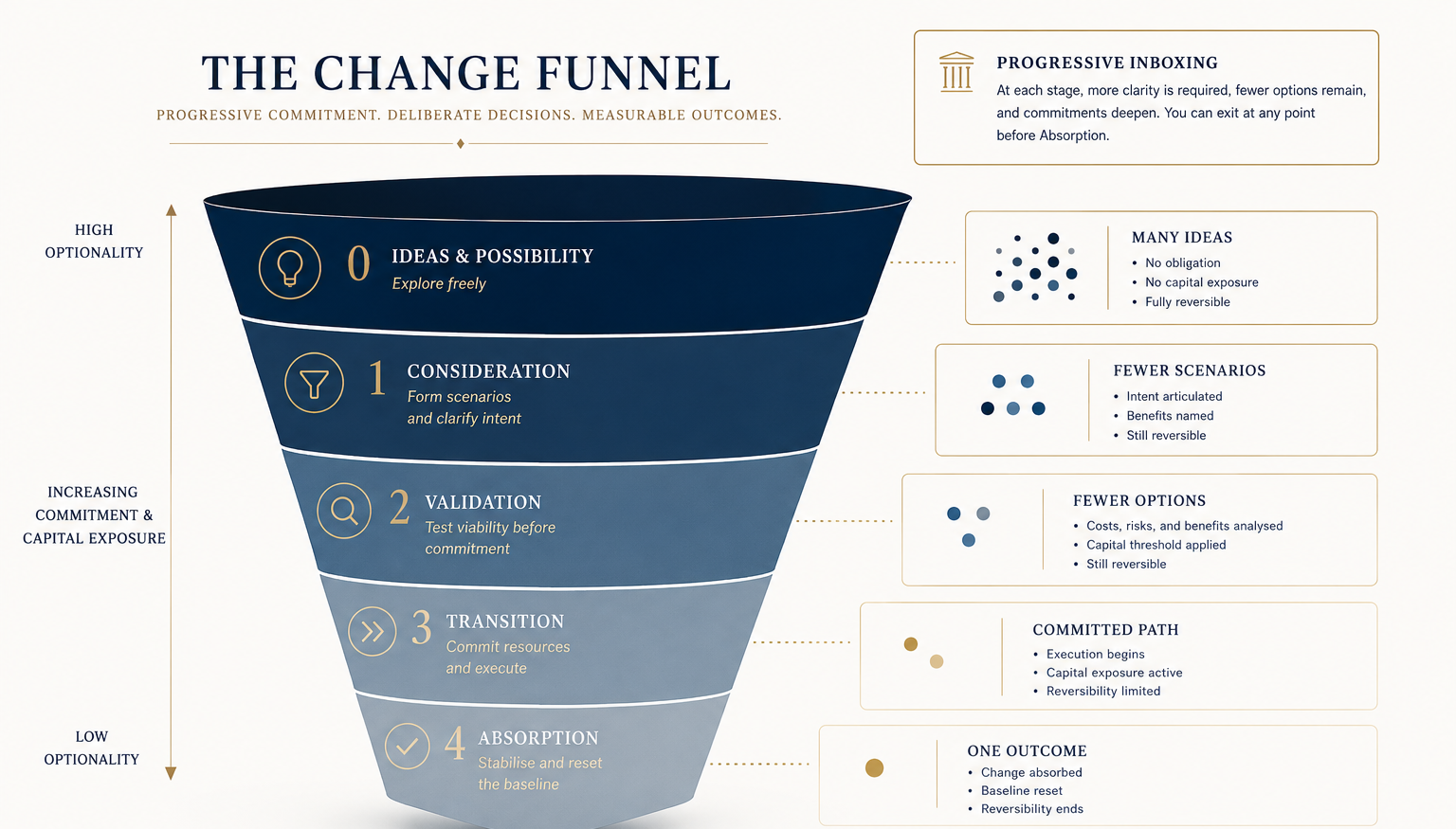
The funnel protects time, funding, attention and optionality before they are absorbed into the plan.
You can exit at any stage until commitment has deepened enough to justify the next step.
Each stage asks for stronger evidence before more organisational capital is committed.
Capital is committed deliberately, outcomes are observed and the baseline is reset only when change is absorbed.
Decision Table helps organisations decide what belongs in the plan, what needs reshaping and what should remain optional.
Where it fits
Decision Table belongs in strategic planning and change governance.
It sits at the point where an idea begins asking for capital.
That is where optionality is highest and exposure is still manageable.
Time, funding, capacity and attention are finite. Decision Table gives the organisation a shared account of where that capital is going, what remains outside the funnel and why.
Commitment follows only after the choice has been tested against direction, exposure and consequence.
Routes to market
Different tables. One Decision Table discipline.
Decision Table is not one generic interface for every organisation. The discipline stays standard, but the table changes for the strategic setting: founder-led businesses, executive leadership, capital allocation, family stewardship and formal governance.
Small Business Table
Founders + owner-operators
For founders and owner-operators deciding which choices deserve attention before the business absorbs them.
Executive Table
Enterprise leadership
For executive teams aligning strategic choices across functions, investment, capability and priorities.
Investment Table
Capital allocators
For capital allocators testing exposure before funding, time, capacity and optionality are committed.
Family Office Table
Multi-generational stewardship
For stewardship choices where continuity, assets, risk and long-range intent need one governed route.
Board Table
Governance
For formal governance where authority, accountability and the institutional record matter most.
Why leaders use it.
Strategy needs a gate.
Many ideas should remain outside the plan. The business needs a disciplined way to decide what deserves commitment.
Capital carries several kinds of exposure.
Financial cost is one exposure. Attention, capacity, optionality, timing and the ability to absorb change matter as well.
The plan should inherit clarity.
The organisation moves with more confidence when the strategic decision has already been shaped, tested and governed.
What changes in the business.
Clearer strategic planning.
Ideas are assessed against the direction of the business before they become accepted priorities.
StrategyBetter capital exposure management.
Time, funding, capacity, optionality and attention become visible before commitment.
CapitalCleaner strategic choices.
Leadership sees better-shaped options because decisions have passed through a governed funnel.
OptionalityStronger leadership agreement.
Executives can see which changes are approved to continue, which are being held and why.
AgreementOften paired with Strategy Realisation Office
Decision Table gives strategy a governed path into the operating agenda.
Strategy Realisation Office keeps the agreed direction visible as the business changes.
Decision Table gives leadership a practical way to govern the choices that determine what enters the plan.
Explore Strategy Realisation OfficeCapital is committed only when the choice is clear.
Join the Decision Table waitlist