Branded. Private label. Distribution. Direct. Contract.
FMCG businesses may own consumer brands, manufacture for retailers, distribute products, sell direct-to-consumer or produce for multiple brand owners.
Thinking / Industry Blueprint
Fast-Moving Consumer Goods businesses create value by manufacturing, marketing and distributing products that consumers purchase frequently.
Success is driven by the speed and efficiency with which products move through the value chain. Small improvements, repeated thousands of times across millions of products, create significant commercial value.
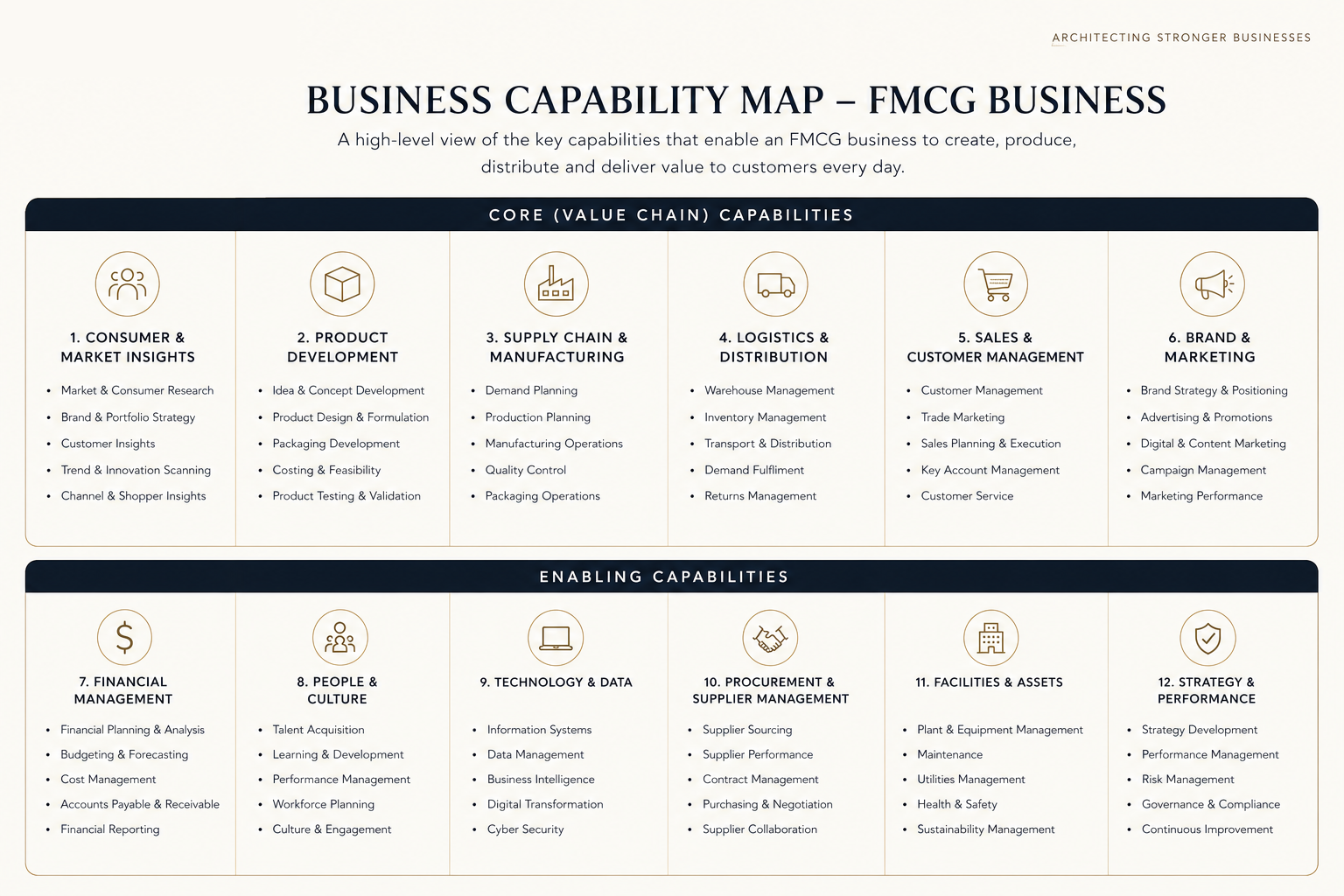
FMCG businesses may own consumer brands, manufacture for retailers, distribute products, sell direct-to-consumer or produce for multiple brand owners.
Revenue growth is usually shaped by market share, new customers, customer retention, distribution expansion and product portfolio decisions.
Gross margin, manufacturing efficiency, waste, forecast accuracy, product mix, procurement, logistics and promotion effectiveness all compound.
Success depends on brand strength, distribution, innovation, consumer demand and manufacturing efficiency.
DemandMargins are often lower, so scale, customer relationships, cost competitiveness and operational discipline matter deeply.
EfficiencyValue is created through distribution coverage, inventory management, supplier relationships and sales execution.
CoverageCommercial performance depends on acquisition, retention, fulfilment, lifetime value and brand loyalty.
RetentionCompetitive advantage comes from capacity utilisation, quality, reliability and strong commercial relationships.
ReliabilityService levels may improve, but working capital rises and slow-moving stock becomes a commercial risk.
Trade-offCashflow may improve, but stockouts can damage customer service and retailer confidence.
Trade-offSales volume may increase, but gross margin and operational stability can suffer.
Trade-offCustomer choice may increase, but complexity grows across forecasting, production, warehousing and commercial management.
Trade-offUtilisation may improve, but excess inventory appears quickly when demand assumptions are wrong.
Trade-offFMCG strategies often focus on market share, gross margin, working capital, forecast accuracy, service levels, manufacturing efficiency, innovation, portfolio optimisation, customer profitability and supply chain resilience.
Increasing production can improve utilisation but increase working capital. Reducing inventory can improve cashflow but reduce service. Promotions can grow revenue while eroding margin.
Too much inventory, poor forecast accuracy, low service levels, margin erosion, siloed decisions, promotional inefficiency, slow product launches, excessive complexity and limited executive visibility are often connected.
Forecast accuracy, demand signals, inventory velocity, fill rate, OTIF, manufacturing schedule adherence, promotion effectiveness, new product pipeline and capacity utilisation show movement before the result arrives.
Capabilities
High-performing FMCG businesses invest in consumer and market insights, portfolio management, product innovation, sales and category management, demand planning, supply planning, procurement, manufacturing, logistics, customer service, commercial finance, enterprise performance, digital and data.
Most operate across executive leadership, marketing, sales, supply chain, manufacturing, procurement, customer service, finance, technology and enterprise performance. The challenge is making those functions operate as one enterprise, not independent departments.
Recommended techniques
Executive Playback creates a shared understanding of commercial performance, strategic priorities and enterprise constraints before significant investment or transformation.
Strategy to Outcome and Commercial Architecture help leaders understand enterprise trade-offs and connect strategic choices to measurable outcomes.
Capability Mapping identifies the capabilities that create competitive advantage and reveals where gaps constrain growth, profitability or execution.
Decision Governance, Enterprise Intelligence and Control Tracking help leaders align demand, supply, inventory, manufacturing, customer outcomes and commercial performance in one view.
Commercial execution is becoming more data-led, more granular and less forgiving of disconnected brand, sales and supply decisions.
The businesses that outperform will strengthen the capabilities and governance required to keep demand, supply, inventory and margin aligned.
Better forecasting only creates value when the business can make faster, aligned decisions from the signal.
In FMCG, strategy becomes real when velocity is governed by shared understanding, not functional optimisation.
Continue to Commercial Architecture