Stores. eCommerce. Omnichannel. Marketplace. Subscription.
Retailers may sell through physical stores, digital channels, marketplaces, social commerce, recurring subscriptions or a connected mix of channels.
Thinking / Industry Blueprint
Retail businesses create value by connecting customers with products through exceptional buying experiences, effective merchandising and operational discipline.
Retailers rarely create the products themselves. Their role is to generate demand, convert that demand into sales and build long-term customer relationships.
Retailers may sell through physical stores, digital channels, marketplaces, social commerce, recurring subscriptions or a connected mix of channels.
Revenue growth is shaped by customer acquisition, loyalty, pricing, promotions, new channels and the ability to convert demand into sales.
Sustainable performance comes from converting customer demand into profitable growth while carefully managing margin, inventory and cash.
Products are sold through physical stores. Success depends on foot traffic, conversion, basket size, inventory availability and store productivity.
StoresProducts are sold through digital channels. Performance is driven by traffic, conversion, acquisition, fulfilment and customer experience.
DigitalCustomers move between stores, online, mobile, click and collect, delivery and service. Advantage comes from making those moments feel like one business.
IntegrationProducts are sold through platforms. Visibility, ratings, pricing, fulfilment and product assortment become critical.
PlatformRecurring purchases shift the focus from individual transactions to retention, replenishment and customer lifetime value.
Lifetime valueGross margin, markdown management, product mix, supplier negotiations, inventory optimisation, shrinkage, labour productivity and fulfilment efficiency all shape the result.
Inventory turns, stock availability, replenishment, supplier lead times, seasonal planning, demand forecasting and markdown strategy are central management disciplines.
Retail strategies commonly focus on sales growth, gross margin, conversion, loyalty, lifetime value, inventory productivity, markdown reduction, omnichannel capability, fulfilment and profitability.
Promotions may drive sales but reduce profitability. Range expansion can increase choice but add inventory complexity. Reducing inventory may improve cashflow but create stockouts and lost sales. Acquisition without retention increases long-term cost.
Declining foot traffic, low online conversion, high acquisition costs, poor inventory visibility, excess markdowns, stockouts, overstocking, low loyalty, channel conflict and limited executive visibility are often connected.
Website traffic, store traffic, conversion rate, average basket size, inventory availability, customer acquisition cost, loyalty participation, stock turn and forecast accuracy show the system moving. Revenue, gross margin, net profit, lifetime value, repeat purchase, inventory turns, markdown rate, GMROI and EBITDA confirm the result.
Capabilities
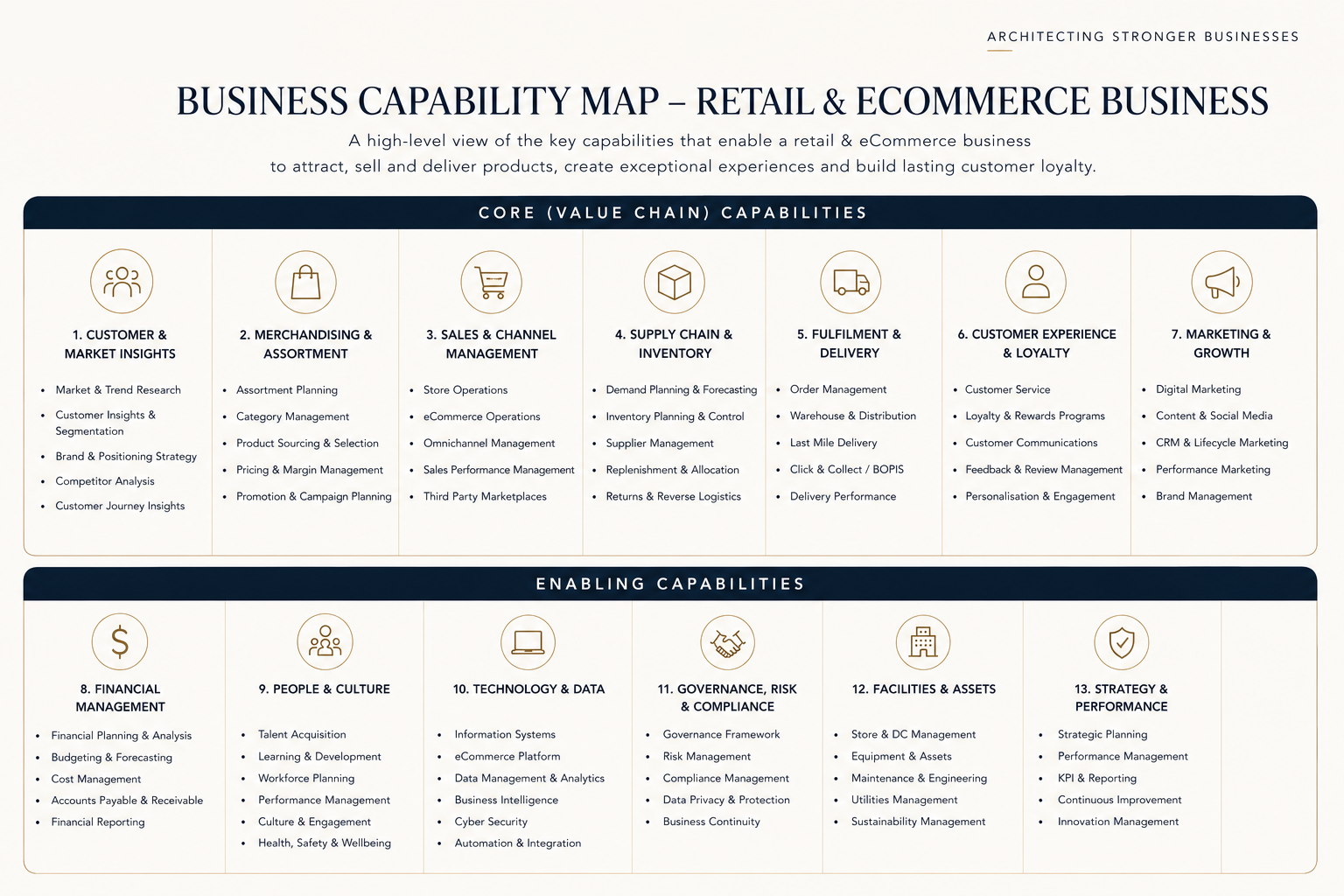
High-performing retail organisations usually strengthen customer insights, merchandising, category management, marketing, digital commerce, pricing and promotions, demand planning, inventory management, fulfilment, customer service, commercial finance and enterprise performance.
Retail businesses typically integrate executive leadership, marketing, buying and merchandising, digital commerce, store operations, customer service, supply chain, finance, technology and enterprise performance.
Competitive advantage comes from coordinating these functions to deliver a consistent customer experience while maintaining commercial discipline.
Recommended techniques
Executive Playback creates a shared executive understanding of customer demand, commercial performance and strategic priorities before major investment or transformation.
Strategy to Outcome and Commercial Architecture help leaders align customer strategy, merchandising, operations and commercial decision making so growth remains both profitable and sustainable.
Capability Mapping identifies the capabilities required to improve customer experience, merchandising, fulfilment and commercial performance.
Decision Governance clarifies pricing, promotion, inventory, investment and strategic decisions. Enterprise Intelligence and Control Tracking bring customer, financial, operational and commercial indicators into one executive view.
Retailers need deeper customer understanding without letting fragmented channels fragment the experience.
The operating model has to connect customer experience, inventory, fulfilment and margin discipline in real time.
The opportunity is sharper judgement, not simply more channels, more data or more tools.
In retail and eCommerce, strategy becomes real when customer demand is converted into profitable, repeatable and well-governed performance.
Continue to Experience Architecture