Trade. B2B. Import. Value-added. Multi-channel.
Wholesale models differ, but each depends on product movement, customer relationships, supplier confidence and disciplined commercial execution.
Thinking / Industry Blueprint
Wholesale and distribution businesses create value by efficiently connecting manufacturers with the customers who need their products.
Unlike manufacturers, wholesalers rarely transform products. Unlike retailers, they rarely create consumer demand. Their value lies in making products available, accessible and delivered efficiently across complex supply networks.
Wholesale models differ, but each depends on product movement, customer relationships, supplier confidence and disciplined commercial execution.
Revenue is driven by customer acquisition, customer retention, product availability, territory expansion, supplier partnerships, product range, cross-selling and sales effectiveness.
Wholesale organisations balance product availability, customer service, working capital, gross margin, distribution cost, sales growth, supplier performance and cashflow.
Products are supplied to trade professionals and commercial customers. Availability, account relationships and service create advantage.
TradeProducts are supplied to retailers, resellers or other businesses. Product range, pricing, inventory, network reach and customer service matter.
B2BProducts are sourced internationally and distributed locally. Supplier relationships, freight, currency, inventory planning and distribution capability become critical.
ImportThe distributor adds technical support, configuration, training, installation or after-sales support, increasing trust and profitability.
ServiceCustomers buy through representatives, branches, online ordering, marketplaces or portals. The objective is to make purchasing simple.
ChannelSupplier negotiations, product mix, warehouse productivity, freight optimisation, pricing discipline, labour productivity and customer profitability all influence the result.
Inventory turns, supplier lead times, customer payment terms, warehouse efficiency, forecast accuracy, slow-moving stock and obsolete inventory shape cashflow and trust.
Wholesale strategies commonly focus on customer service, inventory productivity, market share, gross margin, working capital, product range, warehouse efficiency, supplier relationships, delivery performance and customer profitability.
Increasing inventory may improve service but reduce cashflow. Reducing inventory may improve working capital but increase lost sales. Expanding range may create revenue opportunities while adding warehouse complexity.
Excess inventory, stock shortages, poor demand visibility, margin erosion, warehouse inefficiencies, rising freight costs, supplier reliability issues, fragmented customer information and functional silos often appear together.
Inventory turns, fill rate, OTIF, warehouse productivity, supplier performance, forecast accuracy, order cycle time, customer retention and sales pipeline show movement early. Revenue, gross margin, working capital, customer profitability, inventory write-offs, EBITDA, cashflow and return on capital employed confirm the result later.
Capabilities
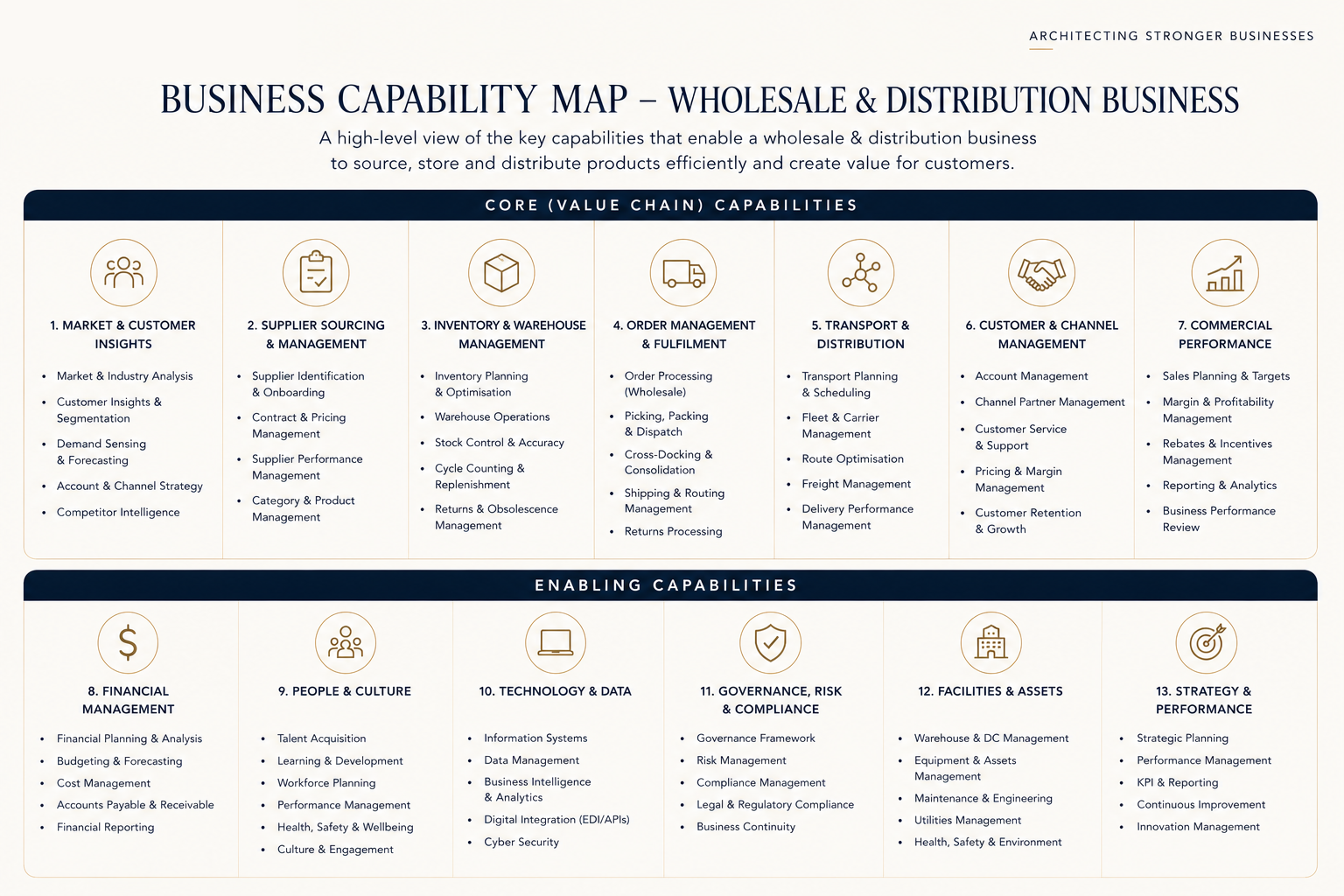
High-performing wholesale organisations usually strengthen supplier relationship management, sales and account management, product management, pricing, demand planning, procurement, inventory management, warehouse operations, logistics and distribution, customer service, commercial finance and enterprise performance.
Wholesale organisations typically integrate executive leadership, sales, product management, procurement, warehouse operations, logistics, customer service, finance, technology and enterprise performance.
Competitive advantage comes from coordinating these functions so products move efficiently while maintaining strong customer and supplier relationships.
Recommended techniques
Executive Playback creates a shared executive understanding of commercial performance, operational constraints and strategic opportunities before major investment or transformation.
Strategy to Outcome and Commercial Architecture help leaders align commercial, operational and supply-chain decisions so customer service, profitability and working capital improve together.
Capability Mapping identifies the capabilities required to strengthen supplier relationships, customer service, inventory performance and distribution efficiency.
Decision Governance clarifies pricing, procurement, inventory, investment and operational decisions. Enterprise Intelligence and Control Tracking connect sales, inventory, warehouse performance, supplier reliability, logistics and commercial outcomes into one executive view.
The distributors that lead will combine digital capability with strong supplier and customer relationships.
Automation can improve flow, but only when the operating model understands the trade-offs it creates across sales, warehouse, procurement and finance.
Better signals matter only when the business can align decisions across the whole distribution network.
In wholesale and distribution, strategy becomes real when the business can move product, protect cash and serve customers as one system.
Continue to Commercial Architecture